 This content is brought to you by the Association for Christians in Student Development (ACSD), a volunteer membership organization committed to equipping and challenging faithful professionals to infuse their Christian faith into student development practice and scholarship. Thoughtful content such as this is made possible by volunteer contributions and the financial support of membership dues. Interested in becoming a member for more awesome content just like this? Join today by clicking here!
The reason magic is so bad at, and so bad for, the formation of persons is simple. Persons are not formed instantly, and persons are not formed effortlessly.
– Andy Crouch (2025), Where the Magic Doesn’t Happen
It was a few hours before Times Square would erupt with celebration and glee, but we weren’t too focused on changing the calendar as we conspired in the kitchen of our home in Northwest Ohio. Instead, my childhood best friend and I were hard at work devising the greatest display of magical performance of all time – complete with plastic thumbs, color-changing handkerchiefs, and expert card-guessing. It was a ten-year-old’s dream, to present a magic show for our families and we did so for several New Year’s Celebrations throughout our childhood, leaving our families in shock and awe as we performed the impossible.
We are drawn to the incredible (literally “not believable”), like my friend and I planning our great New Year’s Eve Magic Show. Andy Crouch (2025) likens such unbelievable magic to the work of the ancient alchemists transmuting substances and manipulating materials to “to finally rise above our creaturely status and command the world like gods.” Unfortunately, as Crouch challenges, our fascination with the magic of alchemy has not necessarily vanished like a magician’s rabbit; instead, in true alchemic purpose, the magic has morphed into today’s technological advancements. The magic boxes in our pockets have captured our attention with their instant, effortless, and impersonal power (Crouch, 2025). Further, those magic boxes now have the incredible qualities of intelligence – even if it is artificial.
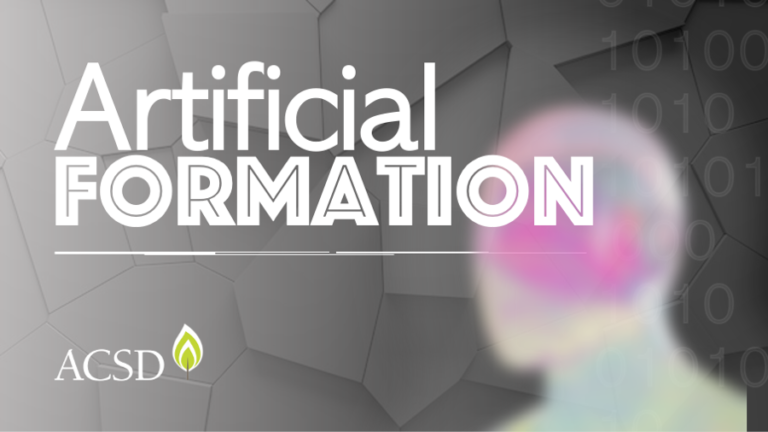
Artificial Intelligence (AI) has overtaken the attention of many of our students (and if we are honest, ourselves) with its instantaneous, effortless, and impersonal qualities. The power it wields finds its way into student papers, emails, cover letters, graphic design, and so much more. AI is ubiquitous, and – I fear – has become more deeply rooted in our psyche, our professional practice, and our formation than any of us would like to admit. And thus, it forms us in particular ways.
The problem, however, is that just like the illusions of our New Years shows and the alchemists’ pursuits of legendary materials like the philosopher’s stone, the magic of artificial intelligence is… well… artificial. It’s fake – a series of prediction models full of ones and zeros designed to keep us engaged with the power of immediacy and ease. And still these ones and zeros challenge our very understanding of identity and formation.
What Does It Mean to be Human?
Many have suggested there is a single preeminent question of our day: What does it mean to be human? (Lausanne Movement, 2024). Astute theologians will point to the very miracle of creation and our identity as image bearers of the Imago Dei:
Then God said, “Let us make mankind in our image, in our likeness, so that they may rule over the fish in the sea and the birds in the sky, over the livestock and all the wild animals, and over all the creatures that move along the ground.” So God created humankind in his own image, in the image of God he created them; male and female he created them. (Genesis 1:26-27, New International Version).
To be human is to be made in the very image of God – full of moral responsibility, authority, and intelligence. Yet Russell Moore (2025) challenges our temptation to consider such defining features as the evidence of God’s image alone. Instead, he explains that from the Old Testament to the New Testament, the Bible “defines [God’s] image not as a what or a how but a who” – the person of Jesus. Paul affirms this incarnational image-bearing when he invites the church of Corinth to be “transformed into his image with ever-increasing glory” (2 Corinthians 3:18, New International Version) and the church of Rome “to be conformed to the image of his Son” (Romans 8:29, New International Version). Tom Wright adds,
The Messiah’s people are to display before the world the truth which is in Jesus himself… Glory does not mean ‘going to heaven and shining like a light bulb’. It means regaining the proper human vocation and dignity, under God and over the world – a vocation and dignity now made possible by the indwelling of the spirit, like the divine presence in the Temple. Or even, we should say, as the divine presence in the temple (p. 169-170).
The delineation between “human” and “artificial” is clear: a vocational purpose towards reflecting Jesus to the world. That is certainly a mission which AI is incapable of predicting or executing. And it is the task of Christian education to foster environments which form within students such a purpose (Smith, 2009). If Christian higher education offers anything less than Christ to our students and the communities we serve, we fail to address this central question of humanness.
I want to suggest three counterformative practices that may help us develop this vocation as image-bearers (both for ourselves and our students), while working against the artificial formation offered by the power of instant, effortless, and impersonal technologies rampant in our work today: creative liturgies which take time, costly habits which invite effort, and connective rituals which redeem the Imago Dei in our brothers and sisters.
Creation
Not to wax overly theologically, but Christian thinkers have long reflected upon the Trinitarian work of creation as an act of mutual and overflowing love among the Father, Son, and Holy Spirit. I’ve often wondered why it took God so long to create the world – seven whole days? If the God of the universe, who spoke the world into existence, took time to create and see that such creation was good, perhaps Genesis 1 also serves an instructive purpose for us to take time and enjoy creation. Further, if we are created in the image of God, we are also called to exercise creativity in reflecting and radiating this abundant love.
As technology quickens our work in our fast-paced environment, helping to make it more efficient, let us exercise discernment and cultivate the love in our own hearts and campus communities to intentionally make the work slow. These liturgies are ever-present on our campuses if we choose to embrace them – from musical ensembles, art exhibitions, recreational extracurriculars, and even scientific inquiry. All can be holy acts of creation when approached deliberately with care. In a technological culture that prizes speed and output, creative liturgies form us by reorienting us towards patience and delight.
Costliness
Dallas Willard explains that “grace is not opposed to effort, it is opposed to earning” (Willard, 2006). While AI gives promise to improve our work by making things easier, we must be cautious of becoming enamored by the temptation of effortlessness. The work of student development, particularly student development steeped in discipleship, is not meant to be effortless!
Still, we are reminded that even our weariest moments reflect the gentleness and humility of Jesus, “for [his] yoke is easy and [his] burden is light” (Matthew 11:30, New International Version). When we sit across from the student in the throes of questioning their faith; when we attend the memorial service for their parent; when they face the reality that the hole they’ve dug for themselves feels hopeless and overwhelming – we must not shy away from these heavy moments by seeking the ease of bypassing or automating. Instead, we must purposefully embrace the personal, emotional, and spiritual costliness they require by building habits and commitments around them.
Connection
The ultimate outcome of the impersonal nature of technology is marginalization. When we spend a majority of time on our screens and engaging in artificial conversation with large language models, we find ourselves isolated, pushed to the fringes of relationships. Nancy Schlossberg (1989) cites that such marginalization results in self-consciousness, leading to challenges related to self-efficacy and sense of belonging. Luckily, she suggests five core elements of helping students know they matter: Attention, Importance, Ego Extension, Dependence, and Appreciation.
Embodied rituals of connection – perhaps in weekly dorm walkthroughs, coffee with a colleague, remembering a student’s name, welcome week events, club meetings, and more – give attention, importance, empathy, dignity, and value to those around us. When we apply these rituals in our relationships with students and through campus programming, we can help students know that they matter and inhibit the gravitational, impersonal isolation inherent in magic prediction models.
Formed for Purpose
One of my fears in writing this piece is that it will be received as technophobic, or technoalarmist at best. This is not my intent. After all, the early technology of fire served a remarkable purpose and brought immense good with its discovery. While it gives us warmth, its flames make for a lousy blanket. We must cultivate the wisdom, awareness, and discernment to utilize it responsibly.
In fact, I encourage our profession to invite the benefits of AI and utilize it for the purposes of improving our work and ultimately better serving students. However, should we fail to do so with an intentional orientation towards our calling as image bearers to reflect the person of Jesus into our students’ and colleagues’ lives, we risk subscribing to the empty magic of alchemy offered by AI. Worse, we risk being formed into the artifice of instant, effortless, and impersonal technologies, rather than formed into the image of a creative, costly, and connective God.
References
- Crouch, A. (2025 January 2). Where the magic doesn’t happen: How technology can interfere with moral formation at school, church, and home. After Babel. https://www.afterbabel.com/p/where-the-magic-doesnt-happen
- Lausanne Movement. (2024). State of the Great Commission: A report on the current and future state (Report prepared for the Lausanne Global Congress, Seoul–Incheon 2024). https://lausanne.org/report
- Moore, R. (2025 July 2). An image of God for an era of AI. Christianity Today. https://www.christianitytoday.com/2025/07/image-god-ai-era-artificial-intelligence-russell-moore/.
- Schlossberg, N. (1989). Marginality and mattering: Key issues in building community. New Directions for Student Services, 48, 5-15. https://doi.org/10.1002%2Fss.37119894803
- Smith, J. K. A. (2009). Desiring the kingdom: Worship, worldview, and cultural formation. Baker Academic.
- Willard, D. (2006).The great omission: Rediscovering Jesus’ essential teachings on discipleship. HarperOne.
- Wright, N. T. (2023). Into the heart of Romans: A deep dive into Paul’s greatest letter. Zondervan Academic.