 This content is brought to you by the Association for Christians in Student Development (ACSD), a volunteer membership organization committed to equipping and challenging faithful professionals to infuse their Christian faith into student development practice and scholarship. Thoughtful content such as this is made possible by volunteer contributions and the financial support of membership dues. Interested in becoming a member for more awesome content just like this? Join today by clicking here!
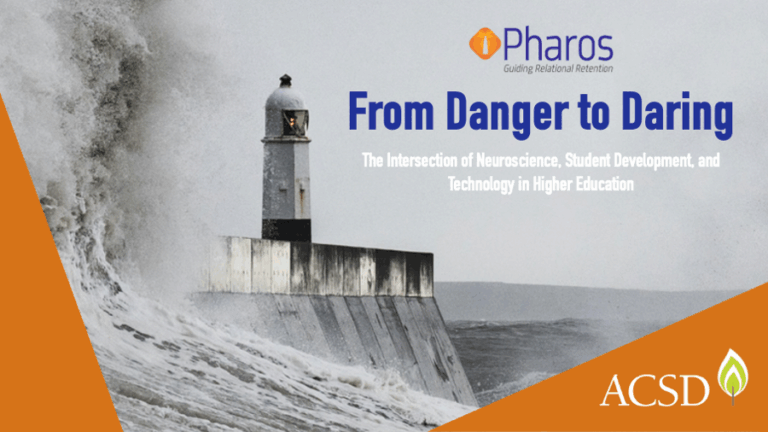
Editor’s Note: This article is an adaptation of a white paper by Pharos Resources. Read the full article here: https://pharos-danger-to-daring.paperform.co/.
Imagine you’re a freshman on your first day of college. Your heart’s racing, your palms are sweaty, and you’re wondering if you’ve made a huge mistake. That feeling of being in danger, or “danger brain,” is your amygdala working overtime to assess for threats in the college environment. This little part of your brain is like an overprotective bouncer, always on the lookout for threats.
“Danger Brain” characteristics can significantly hinder a student’s ability to fully engage in the college experience, potentially leading to isolation, decreased academic performance, imposter syndrome and increased risk of attrition.
Here’s the kicker: for some students, especially those we consider “at-risk,” this bouncer never really clocks out. They’re constantly in “danger brain” mode. It’s like being at a party where you don’t know anyone, and you’re convinced everyone’s judging your dance moves. “Danger brain” can create a heightened awareness of differences, risk aversion, inauthentic behavior, and a transactional mindset.
So how do we help our students tell their inner bouncer to chill out? We want to move them from “danger brain,” where they feel threatened and isolated, to “connection brain,” where they feel safe and open to forming relationships.
The Neuroscience of Belonging
When we successfully shift students from “danger brain” to “connection brain,” we observe a remarkable transformation in their behavior and attitude towards their college experience. By consistently signaling that our campus is a safe place to connect, we can help students lower their psychological defenses and embrace the full richness of the college experience, fostering both their academic success and personal growth. These signals are called “belonging cues” (Coyle, 2018), and they are the way we tell our students, “I am interested in you, and all the work we do together is in the context of that relationship.” As students’ brains begin to seek connections, they become more open and curious and they look for similarities within their community.
By consistently signaling that our campus is a safe place to connect, we can help students lower their psychological defenses and embrace the full richness of the college experience, fostering both their academic success and personal growth.
The Three Pillars of Belonging
The “Three Pillars of Belonging” are three key elements that, when consistently applied, can create a powerful sense of connection and safety for students. These elements act as belonging cues, signaling to students that they are valued, supported, and have a place in the campus community.
Energy means that you demonstrate your investment in your students when interacting with them. So, when a professor notices a student who seems disengaged in class, and instead of ignoring the situation, they make a point to approach the student after class, greet them by name, and ask about their thoughts on the day’s topic it is a way to show genuine interest and engage them.
Individualism is when you recognize and acknowledge each student as unique, valued and important. When meeting with a struggling transfer student, an academic advisor exemplifies individuation by delving into the student’s unique background, interests, and challenges rather than offering generic advice. This personalized approach allows the advisor to recommend tailored campus resources that precisely address the student’s specific needs.
Future Orientation Orientation signals that your relationship with your student will continue and evolve over time. A great example: During a freshman advising session, an academic advisor, Sarah, wraps up by saying to a student, “Jake, I’m looking forward to discussing those business analytics internships when you stop by next week.” Addressing the group, she adds, “I’m excited to guide you all through your college journey. When you walk across that graduation stage in four years, I’ll be there cheering you on! Remember, we’ll check in regularly to keep you on track, starting with our pre-registration meeting next semester.
Shaping the Future of Student Success
As we look to the future of higher education, it’s clear that fostering a sense of belonging and creating psychologically safe environments will be critical to student success. By understanding and applying the concepts of “danger brain” and “connection brain,” we can transform our campuses into spaces where every student feels valued, supported, and empowered to reach their full potential.
The implementation of these neuroscience-informed strategies, supported by technologies like Pharos 360, has the potential to revolutionize student retention and success rates. More importantly, it can profoundly impact students’ lives, equipping them with the confidence, resilience, and social skills they need to thrive not just in college, but in their future careers and personal lives.
References
- Coyle, D. (2018). The culture code: The secrets of highly successful groups. Bantam.
- Pharos Resources. (2024). From danger to daring: The intersection of neuroscience, student development, and technology in higher education.
If you’re unsure how to begin implementing these strategies on your own campus, Pharos Resources is here to help. Pharos partners with institutions to strengthen student success and care systems through data-informed practices, tools, and training that align with your institution’s mission and values. To learn more about how Pharos can support your campus in building intentional, relationship-centered student support, visit their website at www.pharosresources.com.