
We’re currently experiencing technical difficulties. Our team is working hard to restore full functionality as soon as possible.
Please note that the “Careers” tab is still under maintenance. Thank you for your patience. For further questions, email webmaster@acsd.org

Support and Challenge: Student Development Theory 101

This content is brought to you by the Association for Christians in Student Development (ACSD), a volunteer membership organization committed to equipping and challenging faithful professionals to infuse their Christian faith into student development practice and scholarship. Thoughtful content such as this is made possible by volunteer contributions and the financial support of membership dues. Interested in becoming a member for more awesome content just like this? Join today by clicking here!


Christian Student development professionals play a vital role in creating co-curricular formation experiences outside the classroom. We enjoy participating in students’ growth and seeing them thrive. When I was a resident assistant, my residence director (Dr. Neal Anderson, current VP of Student Life at Colorado Christian University) first introduced me to the concept of support and challenge as a fundamental theory of student development. He not only introduced me to this theory but also embodied it in his leadership and connected it to the richness of our Christian faith. For some of us, the support and challenge concept may seem basic, but perhaps this idea may give fresh perspective to new professionals or a meaningful reminder to seasoned professionals as we serve students. 

The Foundations: Nevitt Sanford’s Theory

Dr. Nevitt Sanford (1967) famously coined support and challenge in his book “Where Colleges Fail.” Sanford researched ethnocentrism and anti-Semitism while at University of California, Berkeley, but he’s most famous for his support and challenge theory. The quotes below provide a basic context for his work:

  • “Development occurs when the individual experiences a challenge to which he is competent to respond, and for which he is supported.”
  • “If the support is too great, the person is not challenged; if the challenge is too great, the person cannot cope.”

In my experience, student development staff tend to be great at supporting students but can often struggle with challenging them. A few years ago, a student leader challenged me in this area when she confronted me at the end of the year because I did not challenge her or our student leader team enough. She said I was supporting them, but I avoided challenging them – I taught her support and challenge theory but I was not putting it into practice. I offered support but my neglect of challenge resulted in spiritual, social, and intellectual stagnation.

Mapping Support and Challenge

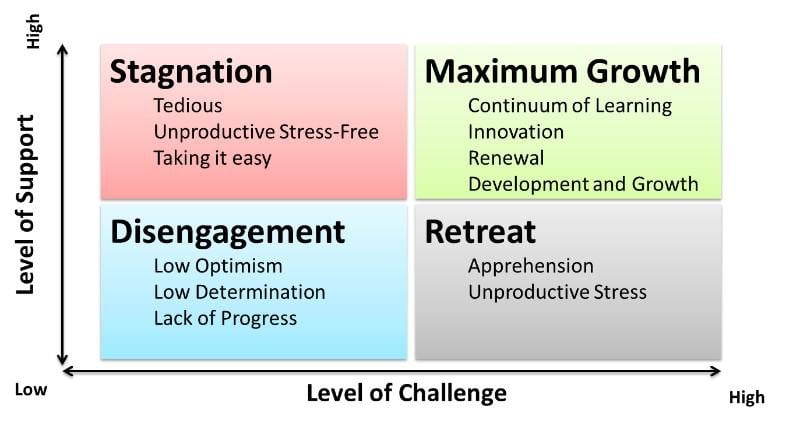
The diagram below describes what occurs when we don’t balance support and challenge. We want students to thrive, and we don’t want students to become stagnant, disengage, or retreat. If we have a student development culture with low levels of support and challenge, students will disengage. A culture of high support with low challenge will create stagnation. An environment of high challenge with low support will result in students retreating. We strive to get the balance right, but it’s not always easy because of further complexities.
Mindsets: Protecting, Striving, Thriving

There are complexities and personal factors to consider when applying support and challenge. Students will be in different places in their readiness to receive challenges. Dr. Wayne Hammond (Flourishing Life, 2026) describes students’ mindsets in three categories he calls protecting, striving, or thriving. Some students will have a protecting mindset. These students tend to avoid challenges, especially by themselves. They are people that need 75% support, 25% challenge. The striving mindset describes students who take on challenges, but only if they can be successful. It could look like 50% support and 50% challenge. Some students will have a thriving mindset. These are students that embrace challenges as an opportunity to learn. They desire 75% challenge and 25% support. I am sure we can all think of different students in diverse places on their readiness to receive a challenge and we need to be attentive to this. We also need to consider the ways Jesus supported and challenged his disciples. 

Jesus: Support and Challenge Master

Did Jesus support and challenge his disciples? Absolutely. Jesus in his very being is full of grace and truth (John 1:14,17).  We see Christ’s support when he says, “come to me all who are weary and heavy laden and I’ll give you rest” (Matt. 11:28-30, ESV 2025). We also see Jesus challenging leaders in the cleansing of the temple (Matthew 21:12-13). The Apostle Paul in the Spirit of Christ exhorted the Ephesians to speak the truth in love (Eph 4:15) which harmonizes support and challenge in the early church. We love students by challenging them, and we need to apply this in a loving way. 

Chrysostom’s Leadership Challenge 

There is a quote by John Chrysostom (1997) that I have found personally challenging as of late. He speaks in a church leadership context, but I think it also applies for us in student development:

The way to judge whether a person is called by God to be a Church leader is to look first at his moral qualities. Is he generous to those in need? Is he gentle toward those who are weaker than himself? Is he patient toward those less intelligent than himself? Is he a loyal and faithful friend? Of course, there are many people who are generous, gentle, patient, and loyal, and yet who are not called to be leaders. Second, look at his spiritual qualities. Does he pray regularly and diligently? Does he read the Scriptures with care? Does he sincerely try to hear God’s will and obey it? Of course, there are many people who truly love God, and yet are not called to be leaders. There is, however, one quality—or rather a combination of two qualities—which marks out the true Church leader. Is he humble about his own abilities, and at the same time can he discern the abilities of others? The most basic task of the Church leader is to discern the spiritual gifts of all those under his authority, and to encourage those gifts to be used to the full for the benefit of all. Only a person who can discern the gifts of others and can humbly rejoice at the flowering of those gifts is fit to lead the Church.

When people look for leaders, they first look at moral qualities. Secondly, people look for spiritual qualities. Chrysostom says the third and most important quality is a combination of personal humility and being able to discern the gifts and abilities in others and nurture growth. Chrysostom challenges us to discern students’ abilities and “rejoice at the flowering of those gifts.” I hope we can be challenged as student development professionals to nurture the growth of students with their gifts; and I believe this best happens in a context when support and challenge is being intentionally applied consistently.

Conclusion 

In summary, students are best formed in a campus community that is both supportive and challenging. Students will be in different places on their readiness to receive challenges with different mindsets. Jesus was the support and challenge master, and student development professionals need to be attentive to their students. St. John Chrysostom inspires us to take a deeper look at our leadership and how we are forming students. Support and challenge theory provides a simple method for us to constantly consider in our work forming students for the good of the world and the glory of God.

References

  • Chrysostom, J. (1996). On living simply: The golden voice of John Chrysostom. (R. Van de Weyer, Comp.). Liguori Press.
  • Flourishing Life. (2026). About Us. https://flourishinglife.com/about-us.
  • Sanford, N. (1967). Where Colleges Fail: A Study of the Student as a Person. Jossey-Bass.
RECENT POSTS

Artificial Formation

This content is brought to you by the Association for Christians in Student Development (ACSD), a volunteer membership organization committed

Read More »
Scroll to Top

Comfort Olugbuyi

Florida Atlantic University, Associate Director for Center for Learning and Student Success and eSuccess   

Workshop: Be the Standout: Elevating your Workshop Skills

Dr. Comfort Olugbuyi comes to Florida Atlantic University with a B.A. in Psychology from the University of North Texas, an M.A. in Youth and Family ministries from John Brown University, and a Ed.D in Higher Education Leadership from Bethel University (MN). Comfort’s research and experience focuses on academic support for college students. She looks for opportunities to support students where they are in the ever-changing world and create partnerships and connections to close gaps and increase retention and overall sense of belonging for students. Comfort joined ACSD June 2008 and has loved the partnership, friendships, mentorships, and overall camaraderie experienced through the years. She currently serves as the Chair of the Diversity Leadership Team, and previously served as New Professional Retreat facilitator (Vice Chair and Chair).

Dr. Comfort Olugbuyi has almost two decades of higher education experience in various positions. She started as a Graduate Assistant Caterer and event coordinator at the University of North Texas, moving on to a Resident Director at John Brown University and Palm Beach Atlantic University (PBA). Comfort then spent over a decade in various student affairs positions at Palm Beach Atlantic University within First Year Advising, Academic Support, and Disability Services. She had additional opportunities to invest and support employee professional development, employee health and wellness, multicultural programming, and NCAA athletics all at PBA. Currently, Comfort serves as the Associate Director of Academic Support at Florida Atlantic University, which is part of the Center for Learning and Student Success (CLASS) where she provides academic support and serves as a liaison to online and hybrid students to all six campuses. When she is not on a college campus you can find Comfort serving at her local church as a welcome host and greeter, volunteering at local community events, or watching local musical theater/play productions.

Why are you excited to be a part of Elevate?
Dr. Olugbuyi is excited and honored to partner with Elevate. There is tremendous value within this professional development opportunity. Comfort is excited to share her ideas through her unique perspectives. She looks forward to collaborating with this group of professionals to share information and offer support in helping to create workshops to enhance ACSD and other conferences.

Shino Simmons

Keck Graduate Institute, Dean of Students

Workshop: Strategic Planning: How to Create a Multicultural Strategy in Your Area of Influence

Shino was born in Japan and raised in Hawaii. Shino has served in higher education for the past 27 years, and she felt the call to raise up the next generation of leaders through higher education. She began her career as a resident director but quickly rose to various leadership positions, including associate director of residence life, directorship in various offices, Title IX Coordinator, associate dean of students, Vice President for Student Affairs, and currently the Dean of Students at Keck Graduate Institute.

Shino received her B.A. in Psychology and M.Ed. in College Student Affairs from Azusa Pacific University. She continued her education at Claremont Graduate University and received her Ph.D. in Higher Education, where she learned from scholars such as Dr. Daryl Smith, Dr. Linda Perkins, and Dr. Susan Paik.

Shino has been married for almost 26 years to Eric, and they have two beautiful, fun, strong, smart, and crazy kids (Kayla, 17 and Travis, 13). She loves having great conversations over a good cup of coffee (and dessert). She especially enjoys seeing the next generation of leaders be trained, equipped and developed so that they can continue to lean into what God is calling them to do.

Why are you excited to be a part of Elevate?
Placeholder

Kevin Villegas

Baylor University, Dean of Intercultural Engagement and Division of Student Life Initiatives

Workshop: Starting with You: Self-awareness and Sustainability

Dr. Kevin Villegas serves as the Dean of Intercultural Engagement and Division of Student Life Initiatives. In his role, Dr. Villegas is responsible for leading a comprehensive approach to empower all students and Division of Student Life staff in the creation of a more vibrant, inclusive, and supportive campus environment as an expression of the Baylor University mission. He has more than two decades of demonstrated leadership experience in a variety of roles within higher- and secondary-education settings, which includes working in or overseeing areas such as campus ministries, student leadership development, new student orientation, student activities, international student programs, athletics coaching, and public relations. He has also led international service trips, co-led a cross-cultural course, and taught strategic leadership in higher education, and leadership and first-year seminar courses for undergraduate students. 

Dr. Villegas is an active member of the Association for Christians in Student Development (ACSD) and served for several years on the executive committee as the chair of the Diversity Leadership Team. He was a recipient of ACSD’s Jane Higa Multicultural Advancement Award in recognition of his significant contributions toward increased understanding and promotion of multiculturalism in ACSD and at Messiah University, where he worked for 17 years. Beyond the realm of education, Dr. Villegas also worked in the entertainment industry and in pastoral ministry. 

A native of New York City, Dr. Villegas is a decorated veteran of the United States Marine Corps, having served on active duty for four years before going on to earn his Bachelor of Arts degree in communication from Messiah College, his Master of Arts degree in Christian Leadership from Fuller Theological Seminary, and his Doctor of Education degree in Educational Leadership from Gwynedd Mercy University.

Why are you excited to be a part of Elevate?
I’m excited to be a part of Elevate because equipping our professional members to better serve and develop multicultural student populations on our respective campuses is vital work. In an increasingly diverse society, knowing how to navigate differences of all sorts with conviction and compassion is needed now more than ever.

Leah Fulton

Trinity Christian College – Palos Heights, IL, Vice President of Student Success

Workshop: Development: Institutional Partnerships and Operational Efficiency

Leah comes to Trinity with a B.A. from Ball State University, an M.A. in Intercultural Studies from Wheaton College, and a Ph.D. in Higher Education with a minor in African American Studies from the University of Minnesota. Leah’s research explores the historical and contemporary motivations and barriers facing African Americans in foreign missions, the history of Black women in doctoral education and the experiences of Black mother doctoral students. She also studies the experience of students and adjunct faculty of color in leadership education.

Leah has over a decade of higher education experience, primarily in student affairs, beginning at Wheaton College where she was a founding member of the Shalom House- a living learning community for students to explore racial reconciliation. She has served as Assistant Dean of Students for the University of St. Thomas and as Associate Dean for Intercultural Student Programs and Services at Bethel University where she launched the Act Six program and the Cultural Connection Center- a campus affinity space designed to cultivate understanding, friendship, and shalom in the way of Jesus. She is also the founder and principal consultant for Project 51, which serves leaders and not-for-profit organizations seeking to grow in their approach to justice, to belonging, to equity, and to diversity.

Why are you excited to be a part of Elevate?
Dr. Fulton is excited to be part of Elevate because of how important it is to support professionals of color in Christian higher education. She benefited from the wisdom and experience of professionals before her and is eager to invest in other professionals to support their ability to navigate the industry, care for students, be well, and effectively make lasting change.

Jerry Woehr

Wheaton College, Director of International Student Programs

Workshop: International Students: Your Role in Their Flourishing

As Director of International Student Programs at Wheaton College, Jerry empowers international students (F-1 visa, MKs & TCKs) to flourish by advising student organizations,  advocating for international student needs, mentoring students, and providing leadership for the F-1 visa student program. Partnering with his office staff and student leaders, Jerry seeks to fulfill a vision of developing students that follow Jesus, as members of God’s global kingdom, through relationships that foster belonging, active learning experiences, and meaningful engagement with their communities. He considers it a privilege to know God more deeply through his experience, and support of, a vibrant and multicultural community at Wheaton.

Why are you excited to be a part of Elevate?
I hope to encourage the Elevate cohort with the experiences and lessons God has given me in higher education, just as so many have done (and still do) for me! I also had the unique privilege of being a part of the team that created the Elevate certificate and returning as a workshop presenter is a gift.

Nii Kpakpo Abrahams

Butler University, Senior Director, Student Experience and Engagement

Workshop: Programming: Innovative Approaches to Multicultural Programming

Nii Kpakpo Abrahams serves as the inaugural Senior Director of Student Experience and Engagement at Butler University. While reporting through Academic Affairs, the office sits between university divisions to partner with and collaborate across campus to cultivate a relationship-rich, high-impact, and seamless student experience that fosters a sense of belonging for all students. He is extremely passionate about helping college students discover, develop, and deploy their giftings and passions. In addition to his work at Butler, Nii is a church planter in the Indianapolis metro area. He holds both his Bachelors and Masters degrees in Communication from Missouri State University. In his downtime, you can find him spending time with his wife and daughter, playing Monopoly Deal, and searching for the best donut shops in Indianapolis.

Why are you excited to be a part of Elevate?

As a Ghanaian-American, I uniquely understand the weight multicultural practitioners carry cultivating belonging on campus. It’s an honor to help develop and encourage leaders who are making an impact across the country!

MORE FAq's

Elevate is geared toward higher education professionals serving in a student-facing, multicultural role and are either (or both) a department of one or are early in their higher education career. Those in positions of directors, coordinators, specialists, or similar titles should consider applying and participating.

ELEVATE is aimed at professionals who are student-facing and oversee programming. We want to equip our student development professionals who are working to make a more welcoming compass experience for students.

Elevate applications will be reviewed by the ACSD Diversity Leadership Team and participants will be selected based on the following criteria:

  • Applicant is eager for new learning and support (department of one, early career professional in this field)
  • Applicant is interested in learning more about best practices within multicultural (higher ed) work
  • Applicant currently serves in student facing multicultural role (part time or full time)
  • Applicants have the support and institutional backing to participate in 2 ASCD conferences, all Elevate workshops, and to eventually use their learning to strengthen the impact of their department/role/institution.
  • Applicant will document how they will contribute to the cohort and shared learning experience

The Diversity Leadership Team will award 2 Elevate scholarships that cover the cost of the Elevate Certification (value of $300). To be considered for an Elevate Scholarship, indicate your interest in the Elevate application and complete the short answer question about financial need.

Yes, Elevate applicants and/or participants are eligible for both the ACSD Multicultural Scholarship and the Elevate Scholarship. The ACSD Multicultural Conference Scholarship covers the amount of the annual conference registration fee.

Yes, either a supervisor or a senior colleague must complete a professional reference form confirming their support of your participation in Elevate and a desire for you to return with lessons (ideas, practices, policies, programs, etc.) that will positively influence your department and work.

No. A supervisor or senior colleague approval is required to ensure that participants have departmental support to implement what they are learning (ideas, practices, policies, programs, etc.) in their department and/or role as a multicultural practitioner.

Participants will continue networking and fostering relationships with their Elevate cohort members in addition to receiving continued support from the ACSD Multicultural Collaborative and the Diversity Leadership Team. 

Elevate participants will be asked to participate in recruitment videos, photos, and provide written testimonials sharing their experience with Elevate.

The Diversity Leadership Team understands department budgets or personal changes may occur between conferences and will work with you to ensure attendance is possible for both conferences.

Yes. The Diversity Leadership Team understands professional changes happen and they will work with you to continue towards completion of the certification.